History and trivia
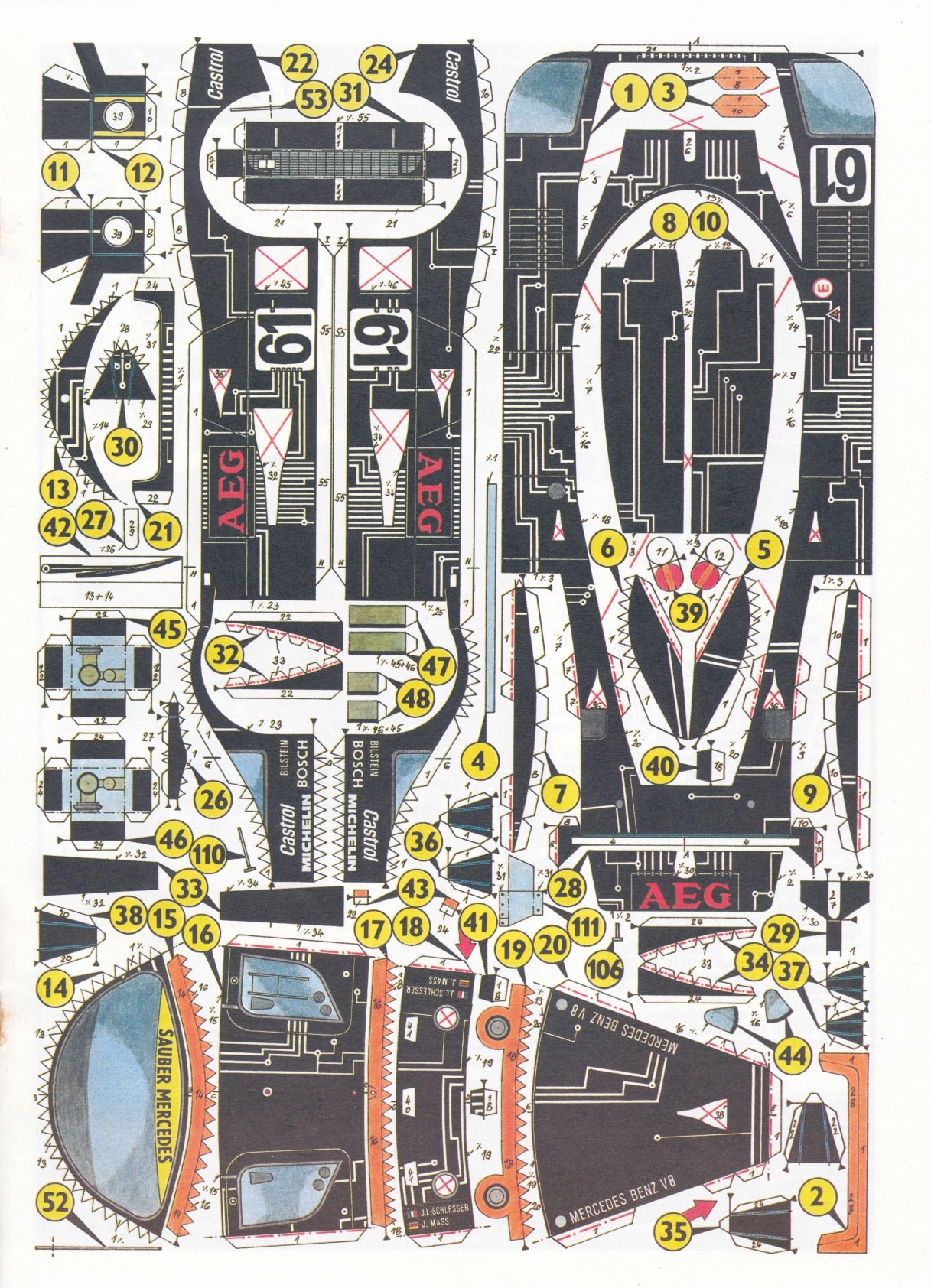
The Sauber-Mercedes C9 grew out of a partnership between the small Swiss team Sauber, founded by Peter Sauber, and Mercedes-Benz, which was looking to return to endurance racing after officially withdrawing from motorsport in the 1950s. Built to Group C regulations, the car used a twin-turbo V8 derived from Mercedes road-going engineering, producing huge power for the era. The team introduced the C9 in the mid-1980s and refined it season after season, and its junior driver program brought in future Formula 1 stars such as Michael Schumacher, Karl Wendlinger and Heinz-Harald Frentzen, who all cut their teeth racing for the Sauber-Mercedes endurance squad.
At the 1989 24 Hours of Le Mans, Sauber-Mercedes scored a historic one-two finish with the C9, while also sweeping that season's World Sportscar Championship. One of the car's most talked-about traits is its top speed on the unchicaned Mulsanne Straight, where it topped 400 km/h — a figure that later pushed the FIA to add chicanes to that section of the circuit for safety reasons. That combination of speed and dominance made the C9 one of the defining prototypes of the Group C era.